
A shaker can be easy to play and still be awkward for a particular lesson. A child may hold it comfortably but struggle to stop on cue. Another may follow the beat more confidently with a handle. When comparing egg shakers vs maracas, these small differences matter more than choosing the brightest color or the largest set.
Both instruments make sound when loose material moves inside a shell. The useful difference between egg shakers and maracas is usually how the player holds and moves them. That affects the activity you can teach, the space it needs, and how easily a group can play together.
Egg Shakers vs Maracas: Start with the grip, not the product name
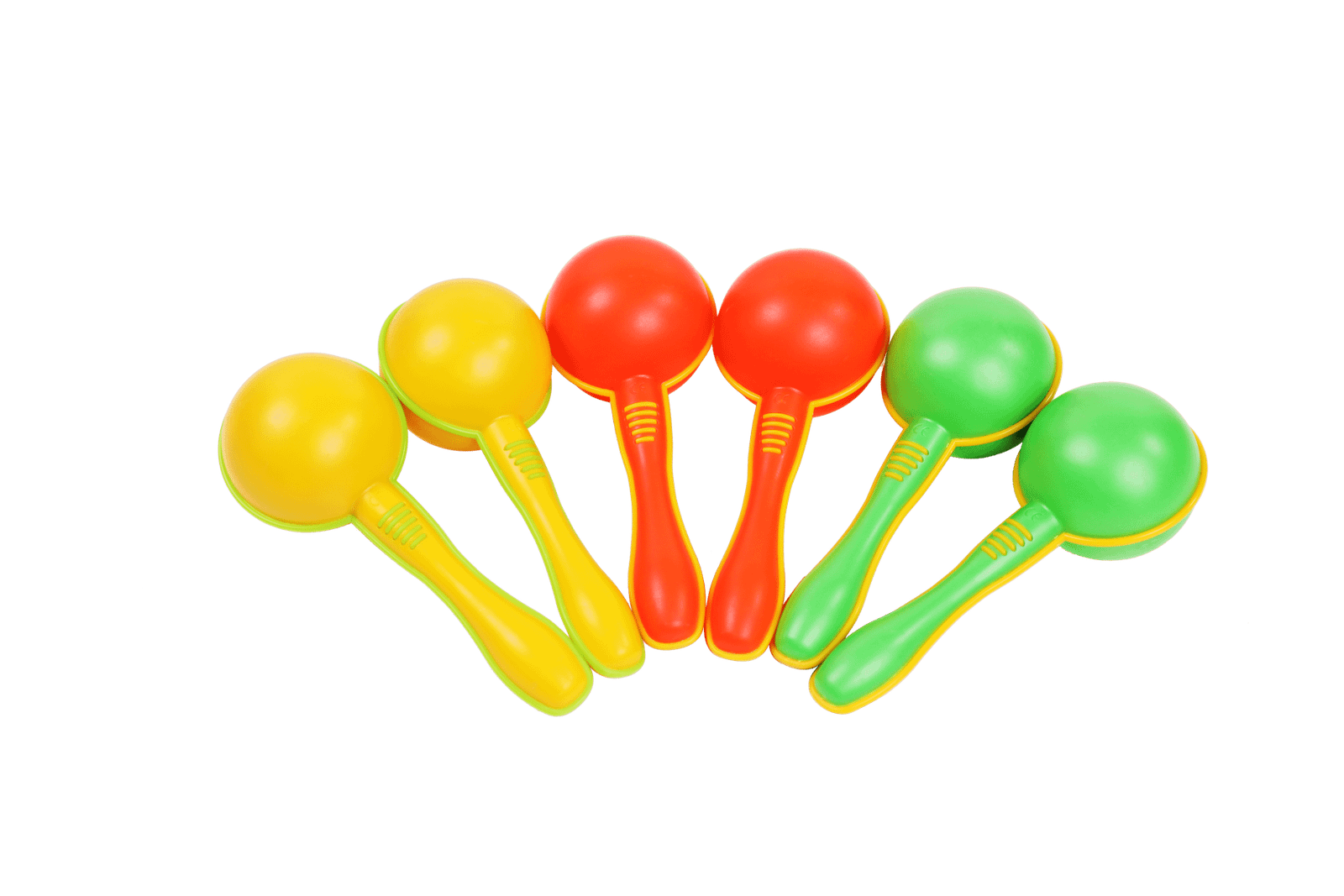
A conventional egg shaker sits inside the hand. The player moves the whole shell, using a short motion or a wider arm movement. A conventional maraca has a handle below its sounding chamber. The player grips that handle and moves the head of the instrument.
The categories sometimes overlap. Yonghe's egg shaker range includes handled versions, while its maracas collection includes several shapes and sizes. Look at the actual shape, dimensions, and grip rather than assuming the category name tells you everything.
When selecting handheld shakers for children, check whether the player can keep a relaxed grip through a short pattern. An instrument that repeatedly slips, twists, or needs repositioning interrupts the music even when its sound is appealing.
What changes during a lesson?
| Teaching need | Try a conventional egg shaker when… | Try a handled maraca when… |
|---|---|---|
| Small movements | You want a compact object held near the body. | A clearly defined handle helps the player control movement. |
| Visible demonstration | Students can see your hand closely. | You want the head and handle movement to be easy to follow. |
| Passing and collecting | A divided tray keeps small items contained. | A basket or compartment accommodates the handles. |
| Sound balance | The particular sample blends with your group. | The particular sample provides the articulation you need. |
This is a starting point for a classroom shaker comparison, not a ranking. Egg shakers are not automatically quieter, and maracas are not automatically louder. Shell material, filling, size, playing force, and the room all affect what listeners hear.
If you are deciding between egg shakers or maracas for singing, test the instruments while someone sings. A sound that seems gentle on its own may cover words when twenty players join in.
Run a five-minute sample test
Use the same short task with both options. This makes the difference between egg shakers and maracas easier to judge without turning the trial into a free-play session.
Listen for the beginning and end of each sound. Watch for extra shakes after the stop signal, a tight grip, or an arm position that becomes tiring. With handheld shakers for children, these observations are more useful than asking only which color they prefer.
For egg shakers vs maracas, a small trial can also reveal that different students need different formats. Using a mixed selection is reasonable if everyone can hear and follow the same musical task.
Choose for the activity you actually teach
A quiet pulse under a spoken rhyme
Start with one instrument per player and a short movement close to the body. The aim is to hear the words clearly while maintaining a pulse. Choose egg shakers or maracas according to which sample supports that balance; do not ask children to compensate for an unsuitable instrument by holding an uncomfortable position.
Movement across a shared room
Check the space between players before adding travel. Handles and larger sounding chambers need room. Demonstrate where the instrument stays during walking and where it rests when the music stops. Begin in place before combining movement with a rhythm.
Alternating groups
Give one group a steady pulse and another a short response. Swap parts after several repetitions. This lets students hear the difference between egg shakers and maracas in a musical context without claiming that either category belongs to only one role.
Check quantities and storage before ordering
A useful classroom shaker comparison includes the practical details after the music stops. Confirm whether the order unit is a single piece, a pair, or a larger set. Thirty students playing one shaker each need thirty playable units, not necessarily thirty pairs.
Decide how you will count the instruments back in. Divided trays can make missing eggs visible; suitable baskets can accommodate handles. Keep damaged items separate rather than returning them to the class supply.
Age suitability belongs to the specific product. Small size, smooth appearance, or a classroom label does not establish that an item is appropriate for a particular child. Review the model information, condition, and supervision requirements when choosing handheld shakers for children.
Which should you choose first?
For egg shakers vs maracas, start with the lesson that happens most often. If your weekly routine is seated singing, prioritize a comfortable grip, controlled movement, and a sound that leaves the voice audible. If students follow large visual gestures, compare handled formats in the actual room.
Compare Shakers for Your Next Lesson
You do not need to settle the choice for every activity at once. Try egg shakers or maracas with one familiar pattern, note what the players can control, and expand from that evidence. Browse the egg shaker models and maraca options to build a shortlist around those observations.