
A Christmas percussion ensemble can give children a clear first concert goal: enter together, leave space for another part, and share an ending. The arrangement below needs no familiar song or difficult notation.
The original piece “Winter Lights” uses three repeating parts for an elementary Christmas music performance. Adjust the group sizes and rehearsal pace to suit the class.
Christmas Percussion Ensemble: Build the group around three jobs
This Christmas rhythm ensemble combines a drum foundation, a lighter four-beat layer, and a bell accent. Players share distinct jobs rather than sounding continuously.
For this school Christmas percussion arrangement, use three groups:
-
Drums: gentle strokes on beats one and three.
-
Shakers: one short shake on each of the four beats.
-
Bells: one deliberate motion on beat four, followed by stillness.
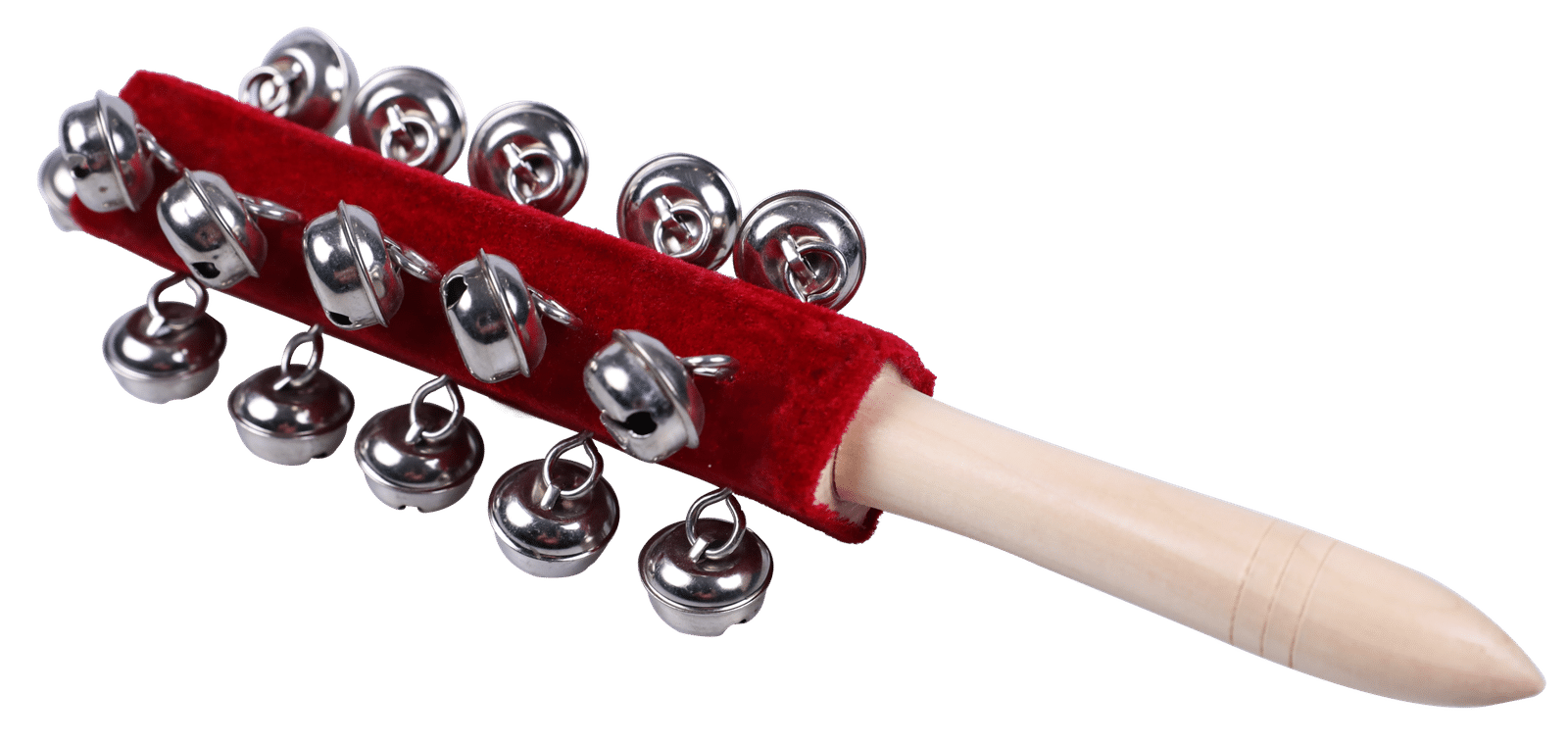
Choose hand drums that suit the players' reach, egg shakers they can control, and sleigh bells that remain audible without covering the other parts. The bell part uses jingling percussion, not a melody or an eight-note bell scale.
If the room sounds crowded, reduce the number of simultaneous instruments. A Christmas percussion ensemble does not become more effective simply because everyone plays louder.
Learn the one-bar pattern before arranging it
Count “one, two, three, four” at a comfortable walking pace. In the chart, X means one controlled sound action, and – means no new action. Bell resonance may continue after the motion; do not shake again during the silent counts.
| Part | Beat 1 | Beat 2 | Beat 3 | Beat 4 |
|---|---|---|---|---|
| Drums | X | – | X | – |
| Shakers | X | X | X | X |
| Bells | – | – | – | X |
Begin Christmas percussion activities with spoken counting and body movements. The drum group pats beats one and three; the shaker group moves on all four beats; the bell group marks beat four.
These simple actions let you hear whether the class understands the pattern. Introduce instruments only after the group can continue without a spoken reminder on every count.
Give “Winter Lights” a beginning, middle, and ending
The piece has 32 bars of four beats. At 80 beats per minute, it lasts approximately 96 seconds, excluding the count-in and applause. Time a rehearsal at your chosen pace before confirming the concert duration.
| Section | Bars | Playing groups | Teacher's focus |
|---|---|---|---|
| Lanterns | 1–4 | Drums only | Establish the pulse. |
| Footsteps | 5–8 | Drums and shakers | Keep the same tempo as the texture grows. |
| Lights | 9–16 | All three groups | Balance the bell accent against the pulse. |
| Quiet Street | 17–20 | Shakers only, softly | Maintain the pulse through a quieter section. |
| Returning Home | 21–24 | Drums and shakers | Reintroduce the drum without speeding up. |
| Celebration | 25–28 | All three groups | Maintain the original patterns. |
| Last Light | 29–32 | All three groups | Prepare one shared finish. |
In bar 32, replace every pattern with one gentle action on beat one, then hold still for beats two, three, and four. Let the sound fade before lowering hands. That final change gives the Christmas rhythm ensemble a clear destination.
The section names help children remember the order. Keeping the elementary Christmas music performance free of extra scene changes leaves more attention for listening.
Rehearse the transitions, not just the patterns
A group may know its rhythm and still miss an entrance. Practice the change from bars four to five without starting from the beginning each time. Then practice the move into the quiet section and the return of the drums.
Use a small set of visible signals: an open hand to prepare, a clear downward motion to begin, and a closed hand to stop. Point to the next group one bar before its entry. Agree on these signals during Christmas percussion activities so students do not encounter them for the first time onstage.
For school Christmas percussion rehearsals, a simple progression is enough:
Do not keep restarting after every small error. Allow a run-through to continue, note one specific issue, and rehearse that section afterward. Children also need practice recovering while the music carries on.
Adapt without losing the musical shape
For less experienced players, remove the drum stroke on beat three. For a small class, use one or two players per part and let others mark silent beats with movement. A larger Christmas percussion ensemble can divide each group into alternating teams rather than doubling the volume.
If bells overwhelm the room, use fewer bell players or reserve them for the later sections. Tambourines can provide an alternative accent, but their response differs from sleigh bells; rehearse the replacement rather than assuming it behaves identically.
The original patterns require no particular pitch, so the arrangement does not depend on matching colored notes. This keeps the elementary Christmas music performance focused on pulse, entrances, balance, and a shared ending.
Make the stage version feel familiar
Mark where each group sits or stands, place instruments before students enter, and keep the teacher's signals visible from every position. Run the opening count-in and the final hold in the same arrangement you will use at the concert.
School Christmas percussion works best when the stage routine feels like the classroom routine. Avoid adding an extra gesture, spoken line, or instrument change immediately before the performance.
Prepare Your Concert Instrument List
Afterward, ask the class which entrance felt secure and where listening helped them stay together. Those observations can shape the next set of Christmas percussion activities. A successful Christmas rhythm ensemble gives children something they can hear and understand: separate parts becoming one piece, with enough space for every part to matter.