
Two drums can fit the same purchasing category and still create very different teaching situations. A connected bongo pair might work on a compact playing station. A taller conga may need a stand, a different seat, and more floor space. Before comparing bongos vs congas by price, decide how students will reach, play, and share them.
The difference between bongos and congas begins with their construction. Bongos normally join two smaller drums into one pair. Congas are taller individual drums that may be arranged singly or in groups. Both have important Afro-Cuban musical traditions; neither is simply a larger or smaller substitute for the other.
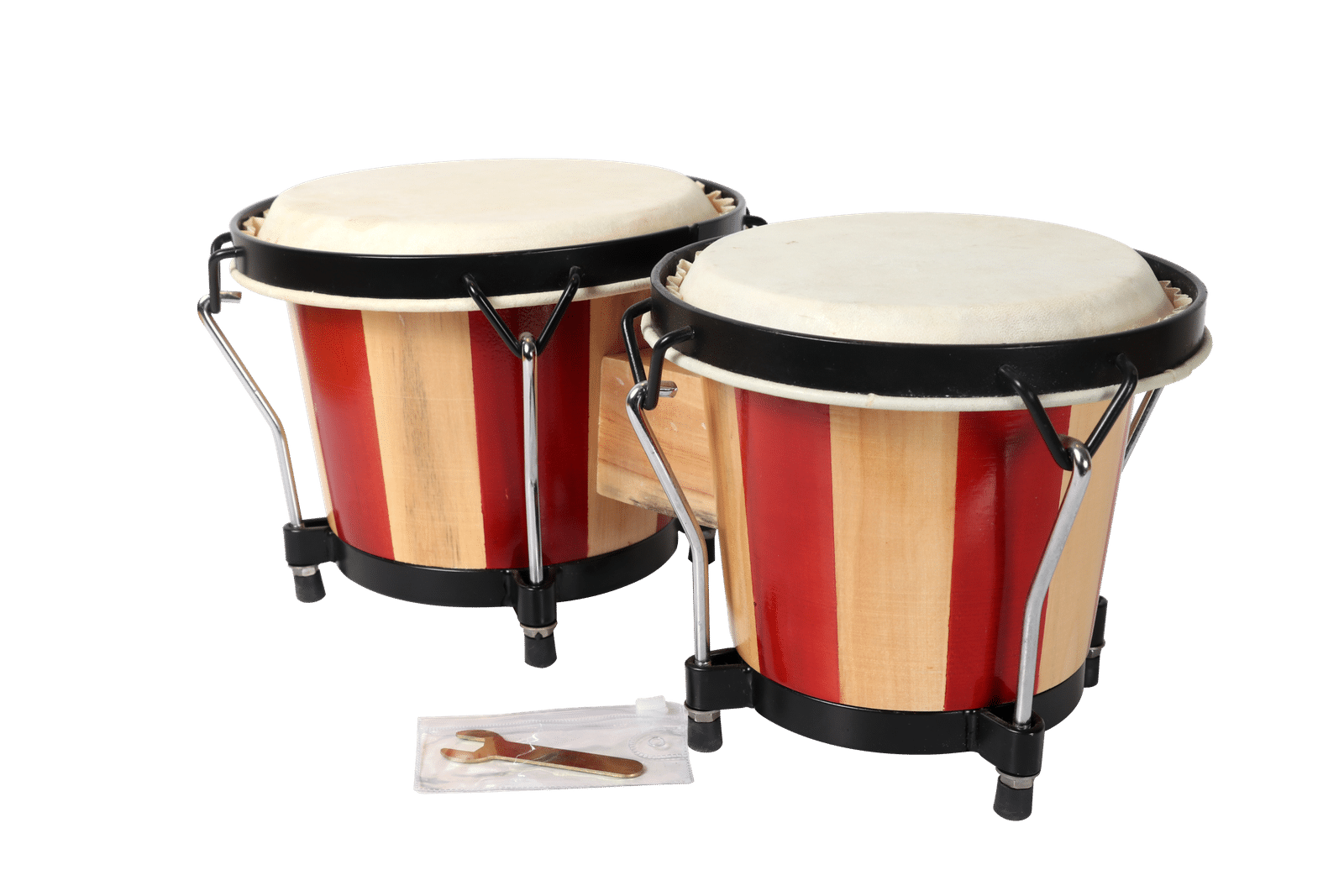
Bongos vs Congas: Listen for a musical role before choosing a size
Bongo and conga sounds vary with the instrument, tuning, touch, and recording conditions. As a general starting point, smaller bongo heads can provide a bright, focused contrast, while larger congas can offer a broader low-to-high tonal range. Neither description guarantees how a particular sample will sound in your room.
Ask one player to perform the same short phrase on each instrument at a comfortable volume. Listen from the students' seats rather than only from the playing position. Notice whether each stroke remains clear beside voices, shakers, or other drums.
If you are choosing bongos or congas for beginners, a useful first question is whether students will explore contrasting strokes or take turns maintaining a simple pulse. That goal gives the listening test a purpose.
Compare the whole playing setup
| Question | Bongos | Congas |
|---|---|---|
| How are the drums arranged? | Usually two connected heads of different sizes. | One or more separate, taller drums. |
| What must be checked? | Pair width, rim clearance, mounting, and reach. | Drum height, support, stability, and reach across the head. |
| What changes during rotation? | A compact station may be possible with suitable support. | Seat and stand positions may need more deliberate adjustment. |
| What is carried or stored? | The pair and any stand or accessories. | Each drum, its support, and any additional hardware. |
This classroom hand drum comparison should include the support system from the beginning. A compact instrument is not automatically comfortable, and a supplied stand is not automatically the right height for every player.
Check that the setup remains stable while a student reaches both playing surfaces. Students should not need to lean, raise their shoulders, or grip a drum awkwardly to keep it in place. If the available support does not fit, change the setup before asking for a longer performance.
Use actual dimensions, not category assumptions
Yonghe's bongo drum selection includes compact and larger connected pairs. The D036-1 model lists 6.5-inch and 7.5-inch heads with a 17 cm height. Its PJ002-1 stand is listed for specified paired sizes, so compatibility should be checked by model.
The conga range includes the compact D046-1 set, listed with 8-inch and 9-inch drums at a 36 cm height, and the taller D046-3 set. These examples show why the difference between bongos and congas cannot be reduced to “small instruments for children, large instruments for adults.”
Measure the space around the student as well as the drum itself. A suitable playing position needs room for hands, legs, supports, and safe entry and exit.
Try a short group exercise
A fair comparison of bongo and conga sounds does not require a complicated rhythm. Begin with four spoken counts. Ask one player to make a gentle stroke on counts one and three, leaving the other counts silent. Another student keeps the pulse by patting their knees.
After several repetitions, switch players without changing the pattern. Then let the drum answer a four-beat phrase spoken by the class. Watch whether the player can prepare, enter, and stop comfortably.
When testing bongos or congas for beginners, keep the first task simple enough that differences in experience do not dominate the result. More force is not a substitute for instruction. Introduce hand placement and suitable strokes before exploring louder sounds.
This is an introductory classroom exercise, not a claim to teach a traditional bongo or conga rhythm. When studying a particular style, use instruction that explains its musical context and technique.
Where does each instrument fit?
A compact shared station
A supported bongo pair may be convenient when students rotate through short listening and response tasks. Test the changeover as part of the lesson. The station only saves time if the next player can sit down and reach it without rebuilding the setup.
A sustained ensemble part
A conga can be useful when the arrangement needs a lower voice or a different tonal response. Compare bongo and conga sounds inside the arrangement rather than choosing solely from a solo demonstration.
A growing percussion collection
When planning bongos vs congas across several classes, consider whether the instruments add distinct roles. Two different drum types may serve the program better than several near-identical models, but only if teachers have the space and instruction to use them.
Make the buying decision easy to check
Record the model, dimensions, support arrangement, included accessories, storage location, and observations from the playing trial. A classroom hand drum comparison becomes much more useful when another teacher can understand why a model was selected.
There is no universal winner in bongos or congas for beginners. Choose the instrument students can reach comfortably and use for the musical work you plan. The difference between bongos and congas should help you assign a role, not force you into a category based on appearance.
Choose Drums Around the Playing Setup
Compare the current bongo models and conga sets, then confirm the exact setup before ordering. In bongos vs congas, the sound, the player, and the available space need to work together.